How Do Clothing Sizes Grade from Small to 2XL?
Understand pattern grading in apparel manufacturing, and how chest, length, and shoulder measurements scale proportionally across sizes.
When expanding a single sample t-shirt design into a complete size run from Small to 2XL, you cannot simply enlarge the entire garment uniformly by 10%. Human anatomy does not scale like a photographic zoom. Pattern grading is the systematic science of scaling garment dimensions proportionally to fit diverse body types.
Grading requires proportional increments across chest circumference, shoulder width, and garment length; inspect our standard apparel size chart and grading guide for exact specs.
The Core Philosophy of Pattern Grading
Garment design starts with a base size pattern—typically a Men's Medium or Women's Small. Once the fit of this base sample is perfected on a live fit model, the master pattern cutter applies commercial grading rules to shift coordinate points across the size spectrum.
As body sizes increase, human bodies gain circumferences (chest, waist, hip) at a significantly higher rate than vertical height. Therefore, grading tables increase chest width by larger increments while keeping length growth gradual.
Standard Commercial Grading Increments for T-Shirts
For standard regular-fit knitted t-shirts, the universal commercial grading increment is 2 inches in total chest circumference (1 inch flat pit-to-pit) between sizes (S, M, L, XL), expanding to a 3-inch jump between XL and 2XL.
Body length typically increases by 1 inch per size step, while shoulder width increases by 0.5 inches, ensuring the collar continues to frame the neck naturally without sagging.
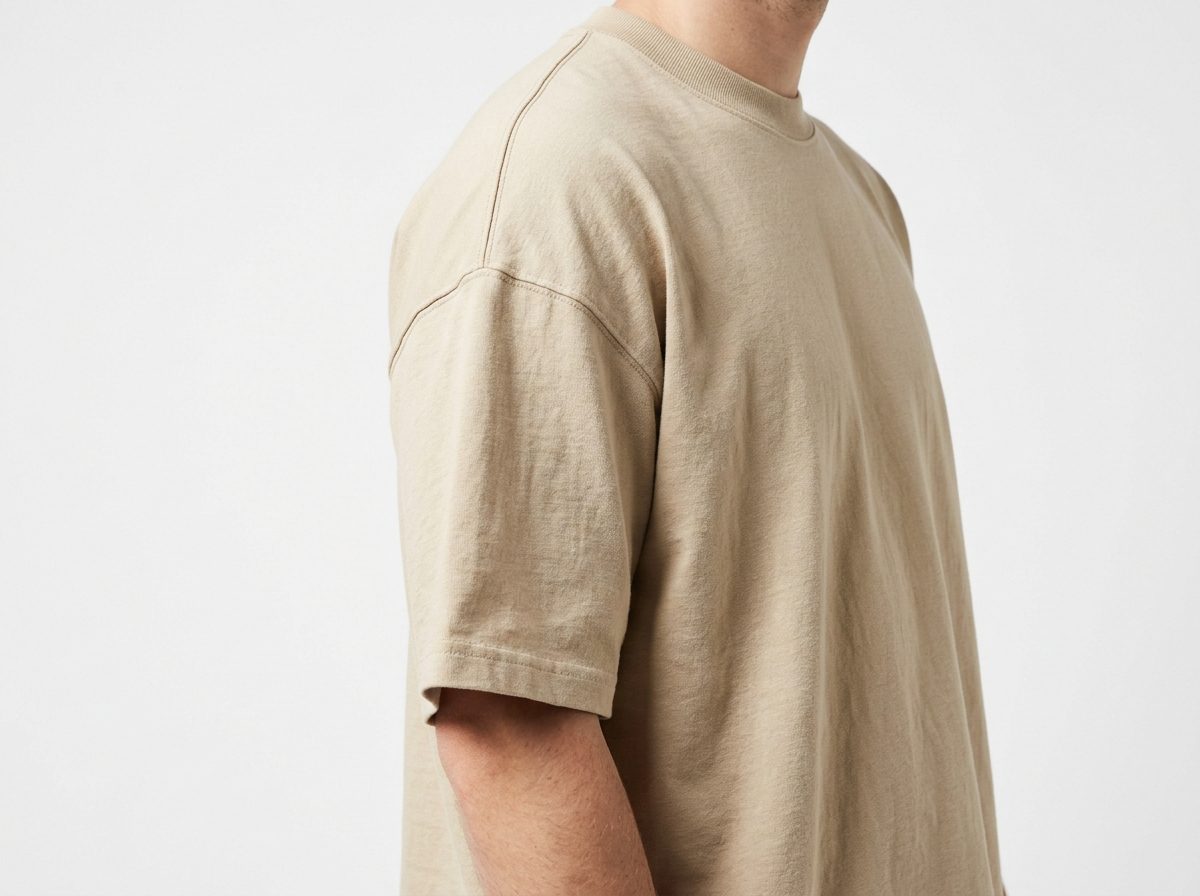
Photo Reference: Precision grading around shoulder slopes and armholes ensuring consistent ergonomic fit across all sizes.
Grading Regular Fits vs Oversized Streetwear Fits
In oversized streetwear fits, the base chest width starts substantially wider (e.g., 22.5 inches flat for Medium instead of 20 inches). However, the grade step between sizes remains consistent at 1 to 1.5 inches flat.
This maintains the intended boxy, dropped-shoulder silhouette across all sizes rather than turning a 2XL into an excessively long nightshirt.
Side-by-Side Comparison
| Size Range | Flat Chest (Pit-to-Pit) | Body Length (HPS) | Shoulder Width (Seam-to-Seam) |
|---|---|---|---|
| Small (S) | 19.0 inches (38" chest) | 27.0 inches | 17.0 inches |
| Medium (Base) | 20.0 inches (40" chest) | 28.0 inches | 18.0 inches |
| Large (L) | 21.0 inches (42" chest) | 29.0 inches | 19.0 inches |
| X-Large (XL) | 22.0 inches (44" chest) | 30.0 inches | 20.0 inches |
| 2X-Large (2XL) | 23.5 inches (47" chest) | 31.0 inches | 21.0 inches |
How Brands Avoid Costly Sizing Mistakes
A frequent beginner mistake is grading the neck opening too wide for larger sizes, causing XL and 2XL shirts to slide off the shoulders. Neck openings should only expand by 0.25 inches across sizes.
Always request sample prototypes in your smallest (S) and largest (2XL) sizes in addition to the base sample (M) to verify drape across the entire grading curve before initiating mass production.
Distribute your size split across S, M, L, XL, and 2XL with ease through our custom sized low MOQ production.
Frequently Asked Questions
Straightforward answers to the 5 most common questions on this topic.
Explore Related Production Lines
READY TO MANUFACTURE YOUR CUSTOM CLOTHING LINE?
Connect with our Goregaon West team to review premium fabric swatches, order sample prototypes, and receive custom bulk pricing.