What Causes Collar Baconing (Wavy Necklines) on T-Shirts?
Learn why t-shirt collars turn into wavy, stretched-out bacon ripples after washing and how 1x1 cotton-Lycra ribbing prevents it.
Collar baconing—the unsightly rippling and stretching of a t-shirt neckline into wavy, curled folds that resemble fried bacon—is one of the most widespread quality complaints in casual wear. Understanding the mechanical and textile causes of baconing allows clothing brands to engineer collars that remain crisp and flat forever.
Baconing happens when poor quality collar ribbing stretches out and fails to recover its elastic shape. Review our anti-baconing round neck t-shirt production using 95% cotton and 5% Lycra ribs.
The Textile Physics Behind the Wavy Bacon Collar
Every time you pull a t-shirt over your head, the circular neckline is forced to stretch over a skull circumference of 22 to 24 inches. Natural 100% cotton fibers possess excellent softness and breathability, but virtually zero elastic memory.
When cheap t-shirts use 100% cotton ribbing without elastane, the stretched cotton fibers cannot snap back. The excess stretched circumference has nowhere to go within the fixed neck opening, forcing the fabric to buckle into vertical wavy ripples.
The Solution: 95% Combed Cotton / 5% Lycra Ribbing
Premium apparel manufacturers solve collar baconing by knitting collar ribbing with 95% combed cotton and 5% Lycra (spandex/elastane) in a 1x1 or 2x2 rib structure.
The invisible core-spun Lycra filaments provide 100% instantaneous elastic recovery, snapping the collar back into a perfectly smooth circular ring the moment it passes over the head.
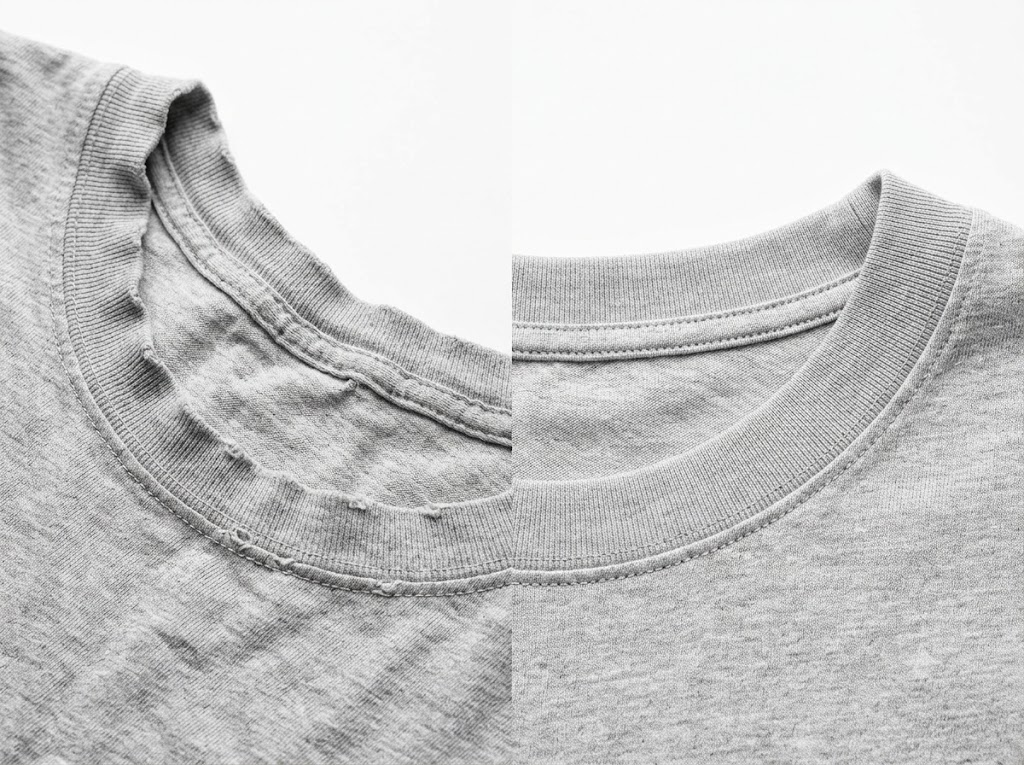
Photo Reference: Wavy 100% cotton collar without elastic recovery compared with crisp 95/5 cotton-Lycra ribbing.
Factory Sewing Tension and Laundry Hazards
Baconing is also caused on the factory floor if an operator pulls the ribbing unevenly while overlocking it to the body panel, creating differential seam tension.
In the laundry, washing in scalding hot water relaxes the cotton yarn twist, while hanging wet t-shirts on wire hangers forces the weight of the water downward through the neck opening, stretching it out permanently.
Side-by-Side Comparison
| Collar Construction | Elastic Recovery Memory | Baconing Risk Level |
|---|---|---|
| 100% Pure Cotton Rib (No Lycra) | Zero elastic memory (stays stretched out) | Very High (waves appear in 2–3 washes) |
| 95% Cotton / 5% Lycra Rib | 100% instant snap-back recovery | Zero / Extremely Low (stays crisp permanently) |
| Self-Fabric Folded Binding | Moderate stretch, thin structure | Moderate (edges can curl and roll over time) |
| Single-Needle Topstitched Collar | Locks seam flat against collarbone | Low (reinforces seam against buckling) |
| Twin-Needle Coverstitched Collar | Commercial heavy-duty reinforcement | Virtually immune to structural stretching |
How Brands and Consumers Prevent Collar Sagging
Apparel founders should mandate 95/5 Cotton-Lycra 1x1 rib collars with twin-needle topstitching in their tech pack specifications to guarantee showroom quality.
Consumers should always wash t-shirts in cold water, avoid using wire hangers that stretch the neck hole, and dry t-shirts flat or folded over a drying rack.
See how dual-needle neck taping and heat-set ribbing are integrated into our commercial garment manufacturing standards.
Frequently Asked Questions
Straightforward answers to the 5 most common questions on this topic.
Explore Related Production Lines
READY TO MANUFACTURE YOUR CUSTOM CLOTHING LINE?
Connect with our Goregaon West team to review premium fabric swatches, order sample prototypes, and receive custom bulk pricing.