Why Do Cotton T-Shirts Shrink and How to Prevent It?
Understand the physics of cotton fiber relaxation, industrial sanforization, pre-shrinking compacting, and cold laundry care.
Finding that your favorite brand-new cotton t-shirt has shrunk a full size after its first wash is one of the most frustrating experiences in fashion. To understand why this happens—and how clothing brands and consumers can stop it—we must look at the molecular tension created when cotton is knitted into fabric.
Cotton shrinkage occurs when yarn tension introduced during high-speed knitting snaps back under hot water. Discover our pre-shrunk custom t-shirt manufacturing in Mumbai with compacting stabilization.
The Physics of Cotton Fiber Tension Release
During the industrial spinning and circular knitting processes, raw cotton fibers are pulled, twisted, and stretched under intense mechanical tension to form tight yarn loops. When the garment is stitched, the cotton fibers remain in an artificially elongated state.
When you wash a t-shirt in water, the liquid breaks the temporary hydrogen bonds holding the stretched fibers apart. The cotton fibers instantly relax back into their natural, curled, unstressed state—causing the fabric to contract in both length and width.
How Factory Pre-Shrinking and Compacting Solves It
High-end apparel manufacturers eliminate post-purchase shrinkage before cutting the fabric through a process called sanforization or tubular compacting.
The freshly knitted cotton passes through heavy steam rollers and rubber compactor belts that mechanically compress and preshrink the fabric. This releases the internal yarn tension in the factory, reducing consumer wash shrinkage from 10–12% down to an unnoticeable 2–3%.
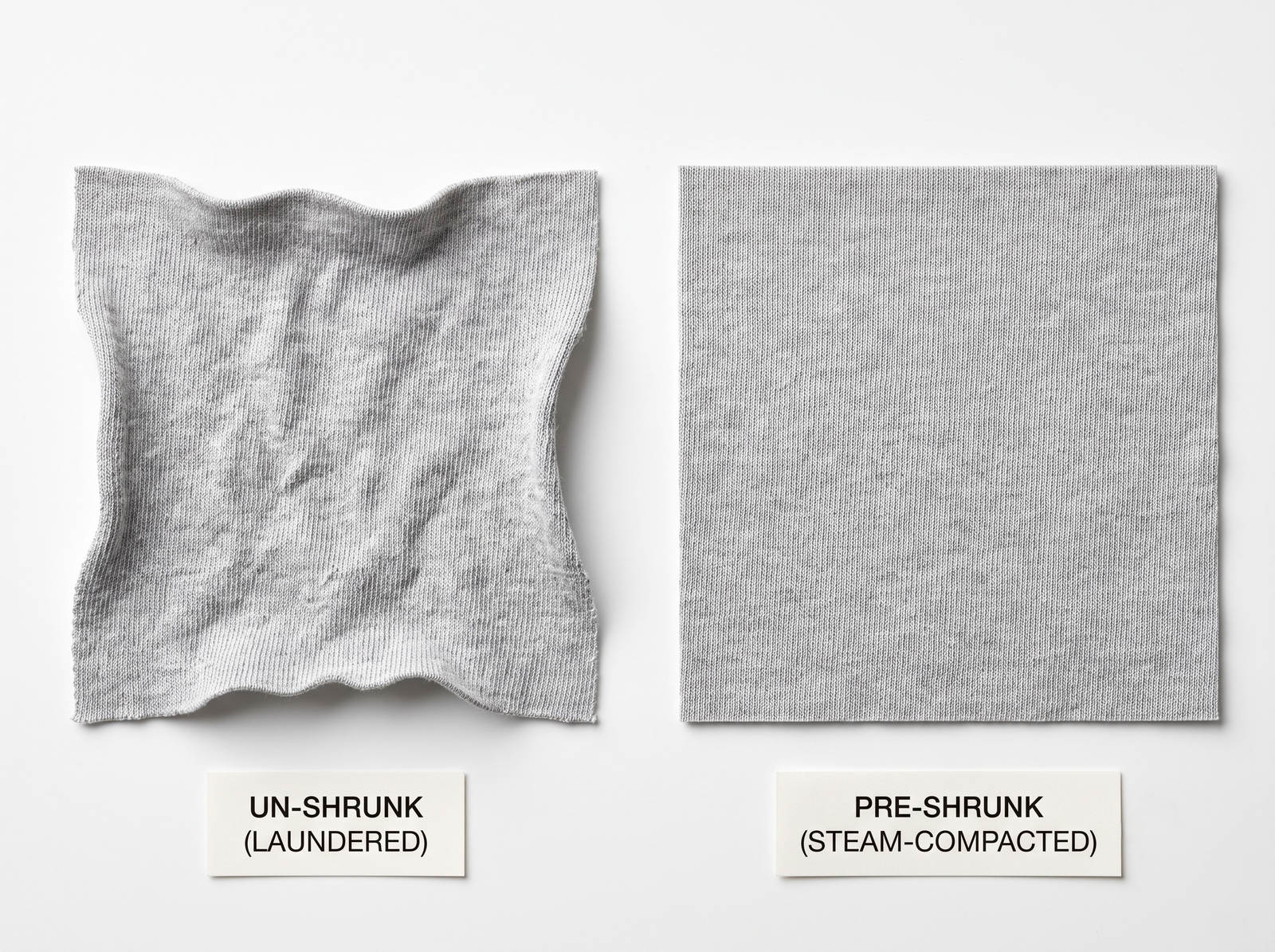
Photo Reference: Distorted yarn loops in raw cotton after hot wash compared with stabilized pre-shrunk compacted cotton.
Why High Dryer Heat Accelerates Extreme Shrinkage
While warm water initiates fiber relaxation, high-heat tumble dryers compound shrinkage through thermal dehydration. The swirling hot air bakes the moisture out of the cotton cells too quickly, forcing the fibers to shrink even tighter.
Hanging garments to air dry on a line or flat rack allows the cotton fibers to dry at room temperature without thermal contraction.
Side-by-Side Comparison
| Shrinkage Factor | Standard Commercial Cotton | Pre-Shrunk & Compacted Cotton |
|---|---|---|
| Initial Wash Shrinkage | 8% to 12% reduction (1 to 2 full sizes) | Less than 3% (virtually unnoticeable) |
| Factory Processing | Cut directly after basic knitting | Steam-heated tubular compactor finished |
| Neckline & Seam Twisting | High risk of torquing / spirality | Seams remain straight and aligned |
| Optimal Water Temp | Must be washed in cold water (<30°C) | Cold water recommended (<30°C) |
| Dimensional Stability | Gradually tightens over 5 washes | Maintains original pattern block fit |
Actionable Guidelines for Brand Founders and Consumers
If you are manufacturing garments, always specify 'Compacted & Pre-Shrunk 100% Combed Cotton' with an audited shrinkage tolerance of under 3% in your factory specifications.
For consumers, always wash cotton garments in cold water, reshape the shirt while damp, and air-dry flat in the shade to preserve the original fit and sleeve length.
Learn how mechanical compactors and stenters lock fabric dimensions in our fabric processing and GSM catalog.
Frequently Asked Questions
Straightforward answers to the 5 most common questions on this topic.
Explore Related Production Lines
READY TO MANUFACTURE YOUR CUSTOM CLOTHING LINE?
Connect with our Goregaon West team to review premium fabric swatches, order sample prototypes, and receive custom bulk pricing.