Why Do Screen Prints Crack on T-Shirts and How to Prevent It?
Understand why printed graphics crack after laundry cycles, from under-curing at the factory to hot washing mistakes, and how to prevent it.
There are few things more disappointing than buying a new graphic t-shirt only to see the artwork crack, split, and flake after just two or three laundry cycles. Understanding why screen prints crack helps both clothing brand founders and consumers preserve graphic quality for years.
Print cracking occurs when ink is under-cured below 160°C. At S P CREATION's professional garment printing and curing facility, every piece passes through temperature-monitored infrared tunnel ovens.
The Primary Cause: Factory Under-Curing
Plastisol screen printing ink is made of PVC resin suspended in liquid plasticizer. To transform into a durable, flexible rubbery solid, the entire depth of the ink layer must reach a uniform cure temperature of 160°C (320°F).
If a garment moves through the curing conveyor tunnel too quickly, or if the dryer temperature is improperly calibrated, only the topmost microscopic skin cures. When the customer wears or washes the t-shirt, the uncured liquid base underneath splits, causing visible hairline fractures.
The Secondary Cause: High-Heat Laundry Shock
Even a fully cured screen print can degrade if exposed to abusive laundry practices. Scalding hot water softens the cured plasticizer molecules in the ink film.
When combined with the vigorous mechanical agitation of a spin cycle and high-heat tumble drying, the cotton fabric shrinks rapidly while the ink cannot, causing the graphic to rip apart at the stress points.
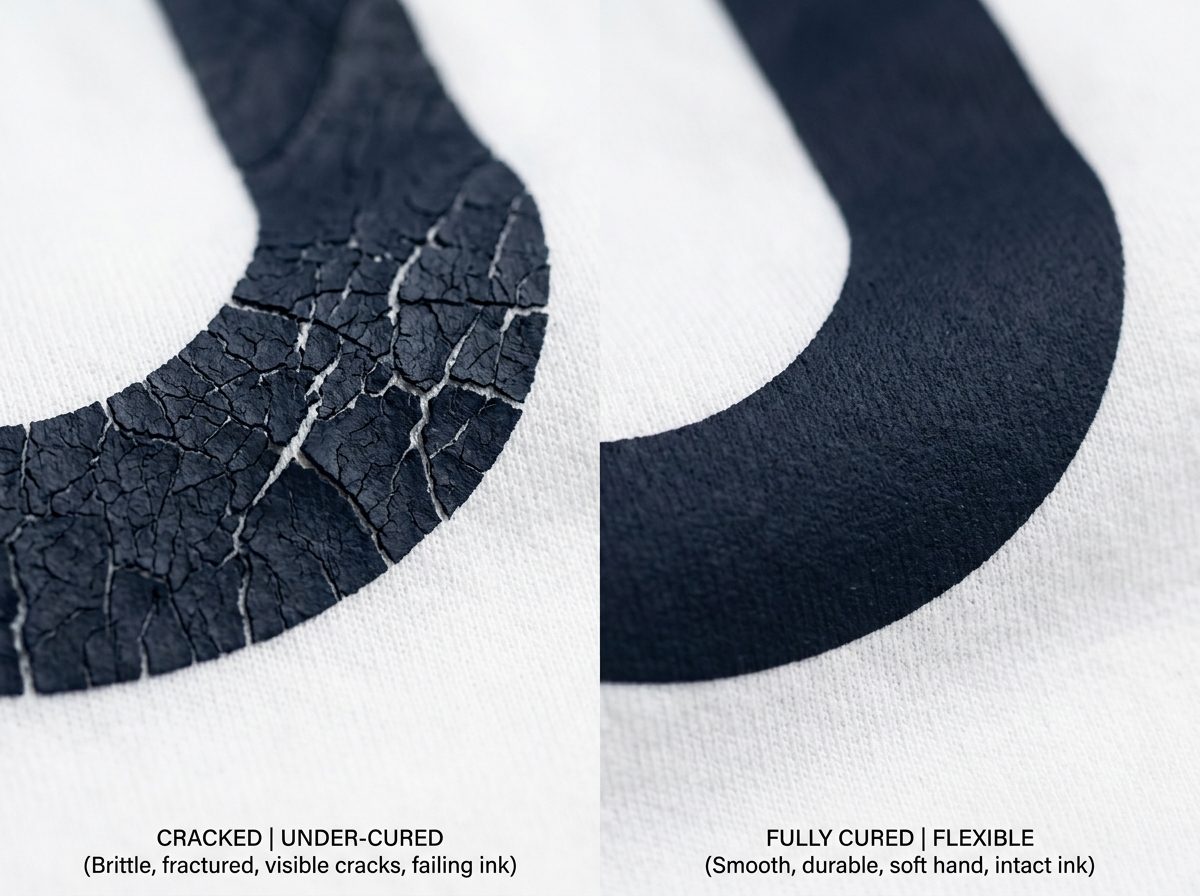
Photo Reference: Under-cured screen print fracturing under stretch compared with fully cured flexible ink film.
How Quality Garment Manufacturers Prevent Cracking
Professional apparel factories run continuous temperature probes (donut probes) through the curing dryer to verify that ink layers sustain 160°C for the mandatory dwell time.
Additionally, quality control technicians perform standard 'stretch tests' and wash-vat testing on fresh production batches to ensure the print stretches elastically and snaps back cleanly without splitting.
Side-by-Side Comparison
| Cracking Factor | Root Cause | Prevention Strategy |
|---|---|---|
| Under-Curing | Ink did not reach 160°C throughout its depth | Calibrated conveyor dryers & donut probe logging |
| Excessive Ink Thickness | Heavy ink deposited without adequate heat dwell | Correct screen mesh selection (110 to 230 mesh) |
| Hot Water Laundry | Scalding water softens and weakens ink polymers | Always wash in cold water (30°C / 85°F or below) |
| High-Heat Tumble Drying | Cotton contracts while hot ink stretches & tears | Hang line dry or tumble dry on delicate low heat |
| Direct Iron Exposure | Hot iron plate melts and tears the rubbery print | Iron garments inside out with a cloth barrier |
How to Ensure Long-Lasting Prints for Your Clothing Brand
If you are manufacturing t-shirts for your brand, partner with factories that guarantee calibrated curing tunnels and perform post-cure stretch quality checks on every production run.
Always include clear wash-care labels directing your customers to wash in cold water, turn shirts inside out, and avoid direct ironing over printed artwork.
We also prevent mechanical stretch cracks by using pre-shrunk streetwear garments with superior dimensional stability.
Frequently Asked Questions
Straightforward answers to the 5 most common questions on this topic.
Explore Related Production Lines

READY TO MANUFACTURE YOUR CUSTOM CLOTHING LINE?
Connect with our Goregaon West team to review premium fabric swatches, order sample prototypes, and receive custom bulk pricing.